

A Yogi is someone who practices yoga. The term Yogi is also used broadly to refer to a Sanyasi or practitioners of meditation in most of the Indian traditions. The practice of Yoga is really the art of creating ultimate balance and harmony and it is about maximizing the human beings’ potential. Yogis have considered the importance of the qualitative aspects of health for thousands of years. Yogis engage in definite, step by step procedures by which the body and mind are disciplined and the souls are liberated. Health is discussed in various ways, for most of the people it is defined as that ‘state’ in which they are able to function without any hindrance where as in reality, health is a part of our evolutionary process towards Divinity. For many people, the definition of being healthy simply means not getting sick too often or not having physical discomfort.
The Importance of Ahar, Vihar, Achar, and Vichar for Healthy Living

To understand health in a complete way, we should know about the basic four pillars and the Panchakoshas well. The four pillars Ahar, Vihar, Achar and Vichar are to be taken care equally to lead a healthy and happy life. If one of them is ignored, then we shall bear pain, disease and suffering to some intensity. The Panchakoshas or bodies constitute a person : Annamayakosha-the body of nourishment; Pranamayakosha-the energy body; Manomayakosha-the mental body; Vignanamayakosha-the intellectual body; Anandamayakosha-the body of joy.
From a Yogi’s perspective, a healthy body is that which has wealth of the body[kaya sampat], the vitality of breath, the peace of mind, positive attitudes and healthy expression of emotions. In fact it makes clear that unless harmony of complete human system is achieved, the person is not in a state of health. Yoga is a complete science of life which deals with Physical, Mental, Emotional and Spiritual health. Various aspects of yoga help in the prevention and management of stress, hence enabling us to live a healthy life in a dynamic state of well-being.
Physical health in Yogic science:
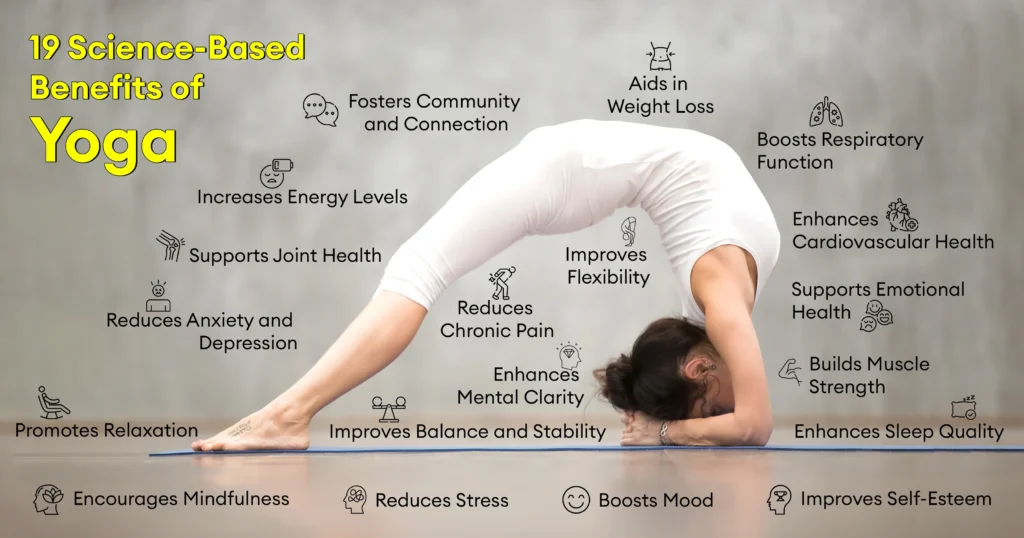
Millions are practicing yoga nowadays for its fitness benefits. Yoga makes your body flexible, steady and strong. It solves many problems such as constipation, anxiety, digestive disorders, hormonal imbalances, respiratory and cardiac problems, hypertension, obesity, allergies and reproductive disorders and so on… Most of yogasanas are being practiced for various benefits respectively, some of the commonly placed asanas with their benefits: Padmasana, Siddhasana, Sukhasana gives steadiness and stability to the body so that one can sit for meditation for a prolonged period.
Hamsasana and mayurasana can give strength to the arms and shoulders, improve digestion, remove constipation and remove toxins from the body. Backward bending asanas like Makarasana, Chakrasana, Bhujangasana, Ushtrasana are good for back and spine problems by strengthening supporting muscles and also by increasing the flexibility. The Hatha yoga practice of Neti gives nasal hygiene, removes sinusitis, relative allergies, headaches and migraines. Surya namaskara is a set of yogic exercises that vitalize the body, remove lethargy and depression and burn calories.
Yoga at Pranic level:
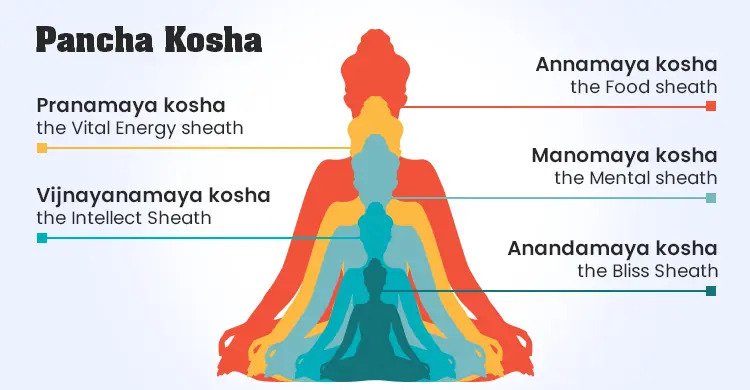
The‘Pranamaya kosha’ or the energy sheath is our vital body. It is responsible for physiological functions like digestion, blood flow, excretion, nerve impulses, body movements and removes all the imbalances such that it reduces anxiety, hypertension and corrects all the hormonal imbalances. Pranayama is mainly designed for improving our vital energy[prana], reduces the carbon di-oxide content in the blood and increases the self-healing properties of the body thus increasing the lifespan. Prana is directly connected to the‘Annamaya kosha’-the physical body and ‘Manomaya kosha’-the mental body, thus when prana is controlled, body and mind are controlled simultaneously as well.
Mental and Intellectual health in Yogic science:

Yoga practicing with breathe awareness, pranayama and meditation can help to bring calmness to the mind reducing anxiety and tensions. A calm mind is a requisite for meditation and higher practices of Samadhi, which leads to spiritual evolution. Fluctuations of mind can be removed by Hatha yoga practices like Trataka[concentration of one point or object] and pranayama. ‘Vignanamaya kosha’[Intellectual sheath] deals with our discrimination and decision making abilities. The intellect is subtler than the mind, yet the state of mind can affect our decision making. Our mind is like a monkey that is constantly active without our permission, this is to be controlled, only then the contemplation of nature of the self is possible without obstruction.
The bliss sheath in Yogic science:
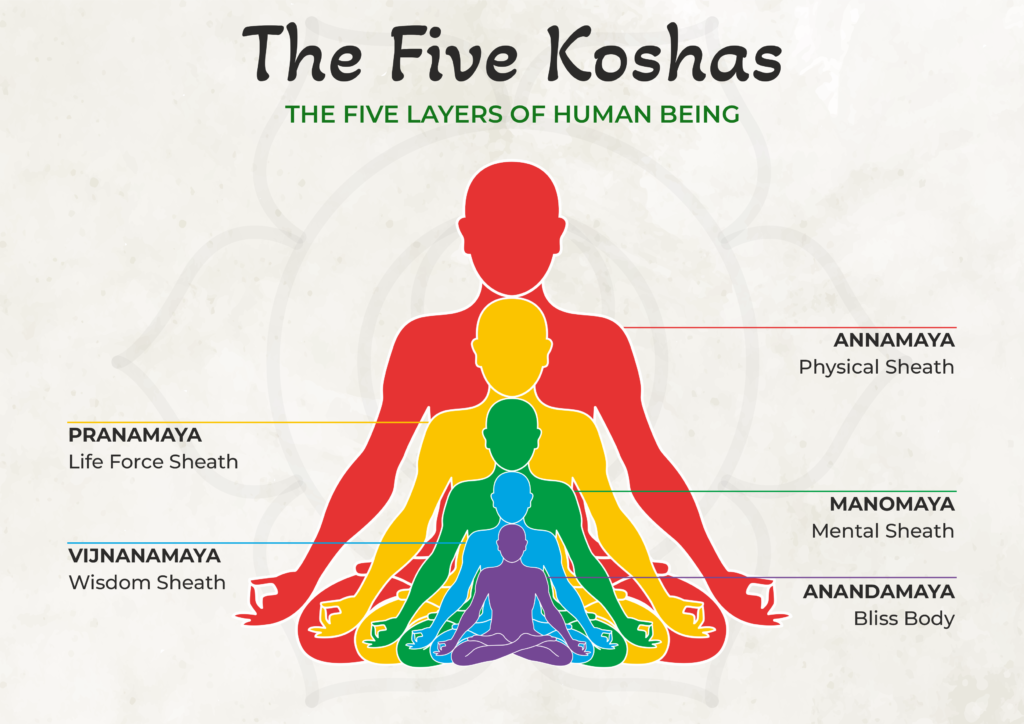
Anandamaya kosha’[bliss sheath] is the innermost part of our being. Bliss is the essential nature of the soul. In some of the scriptures, soul is described as Sat-Chid-Ananda or Being-Consciousness-Bliss. It is very difficult to talk how yoga can benefit our bliss sheath. In fact, it may not. Bliss is our own inner nature and we have to remove the obstacles that prevent experiencing the inner bliss. But yoga reduces all the external turbulences and distractions, thus giving steadiness of mind, prana, body and gives us back our sense of well-being.
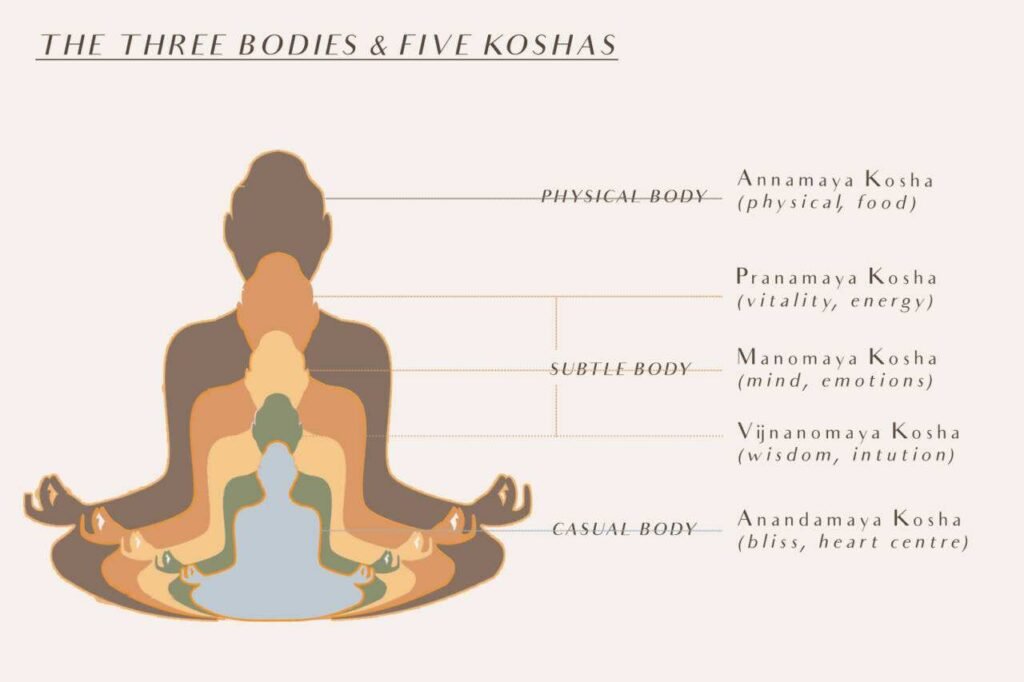
When it comes to the Identity, when we observe our body, we say “This is my body; this is my arm and my leg and my head…….” When we go a little deeper within ourselves, we recognize our thoughts and feelings. And we still say “These are my thoughts, experiences…..”, and so forth. This actually means that everything belongs to us, but it is not identical to us. The “self” is apparently something else. The body, the thoughts, emotions and intellectual knowledge are merely skin that cover nucleus of our existence. We can only experience this when we go deeply within ourselves and penetrate the numerous layers that cover it, only then we can attain finally the Moksha[Liberation].
Those who maintain their mind and understand that completely will no longer be affected by fear. Those who establish their awareness free themselves from unhealthy thoughts and actions, develop the self-control necessary to achieve their goals. Hidden inside the subtler body is composed of pure joy, it is experienced as pure happiness, delight and bliss. The inner bodies are the sources of our well-being during life and are the vehicles we travel in after death.
Read More: The Yoga Asanas and its various concepts in modern days
YOGIC CONCEPTS OF DISEASE:
Disease is the state of the body as well as mind which disturbs the ideal state of health, which is considered as an obstacle to integrative oneness of yoga. Modern lifestyle and practices are creating lots of stress which is leading towards numerous diseases related to the body and mind and again which are inter-related to each other where the effect of a disease starts from an individual to a whole up to universal level. Disease is not which is to be feared, but is an indicator of where we have been erroneous in our lifestyle, practices, thinking pattern, diet. Suffering is a dynamic springboard in our evolution, for which the human should have a right attitude. Yoga helps us train our whole process of thinking thus creating right attitude for evolutionary growth, in every moment of our life.
The science of Yoga has numerous practical techniques as well as advice for proper life style in order to attain health and maintain the state of wellbeing. Bahiranga practices such as Yama, Niyama, Asana, Pranayama help produce physical health while Antaranga practices of Dharana and Dhyana work on producing mental health along with Pratyahara. Yoga helps in Preventive, Restorative and Promoting positive health that will help us to build our positive health balance. This concept of positive health is one of Yoga’s unique contributions to the modern healthcare as yoga has both a preventive as well as promotive role in the healthcare of masses. It is inexpensive and can be used along with other systems of medicine in an integrated manner to benefit the patients.
In this way the new definition of Health not only means greater health and well-being for us as individuals, but also as a larger community, a larger whole. This means that we can not only heal and enhance our own bodies and lives, but can also heal and enhance the overall health of the whole planet as well.